Buying for a healthcare clinic isn't one procurement job — it's at least five, and treating it as one is how budgets quietly disappear.
I'm the office administrator at a 62-person multispecialty clinic. Since 2020, I've managed our medical and facility supply ordering — roughly $400,000 a year across 14 vendor relationships. I'm not a clinician. I'm the person who verifies W-9s, questions line-item prices, and makes sure the invoice matches the contract before finance cuts a check.
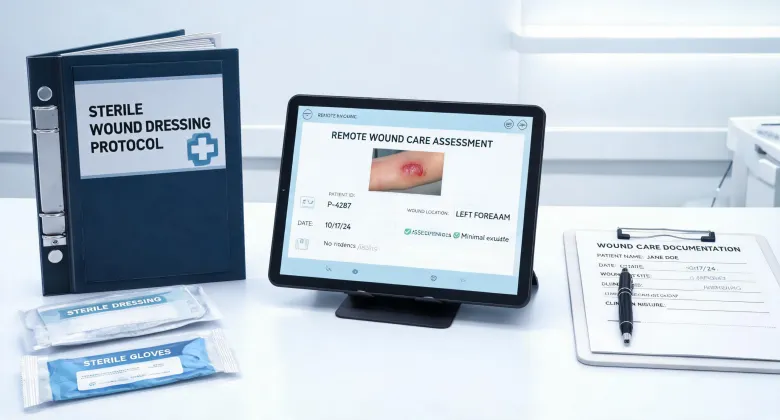
The first rule I'd give any new clinic buyer: separate recurring clinical supplies from one-time capital equipment before you talk to a single sales rep. Concretely, we buy advanced wound dressings and surgical gloves from Mölnlycke Health Care US LLC. We buy hospital beds, dental units, and rehabilitation equipment from other manufacturers. That division isn't a gap in Mölnlycke's catalog — it's how the medical supply industry is organized.
Get the company names right before you touch a purchase order
A surprising amount of procurement confusion starts with company names. Mölnlycke Health Care AB is the Swedish parent company headquartered in Gothenburg. The U.S. entity that appears on our contracts and invoices is Mölnlycke Health Care US LLC. Same product family — different legal names. (Should mention: this two-name structure is common in medical device companies, so it's worth checking for any European supplier you onboard.)
That detail cost us real time once. When AP first processed an invoice from our new Mölnlycke account, the remit-to address said US LLC, but the signed agreement referenced Health Care AB. The invoice went into dispute, and I spent an afternoon reconciling the two. If you're setting up a vendor file, add both legal names with a note linking them, because finance won't assume they're the same.
What Mölnlycke actually sells
Mölnlycke's product line is narrower than a lot of people expect when they search the name for the first time. The company focuses on surgical and wound-care products for clinicians. In our supply closet, that means dressings like Mepilex, Mepitel, Melgisorb, and Mepiform, plus Biogel surgical gloves and Barrier surgical drapes and gowns.
The common thread in the dressing line is Safetac, their silicone adhesive technology. Our wound-care team explains it this way: the dressing seals around the wound, but the adhesive doesn't bond to the wound surface, so changing it is gentler for the patient. Here's what matters on my side: these are high-volume consumables. They're reordered constantly, don't require installation, and get expensed rather than capitalized.
Capital equipment lives in a different world
The confusion starts when a clinic plans a new service area and tries to buy everything under one "medical equipment" banner. Here's what drove it home for me. In 2024, our clinic added an oral surgery suite and a short-stay observation area. Within the same quarter, I renewed our Mölnlycke dressing and glove agreement, requested quotes for two hospital beds, priced dental units for the oral surgeons, and ordered replacement rehabilitation equipment for physical therapy.
It was all medical, but it was never one procurement project. Wound-care products are repeat purchases with established par levels. Beds, dental units, and rehab gear are capital assets with delivery lead times, installation requirements, and service agreements. Different products, different budgets, different approvals.
What is a hospital bed? The buyer's version
This is the phrase that brings a lot of clinic administrators to the internet, usually after a physician assumes they already know. Here's the definition I write into capital requests: a hospital bed is an adjustable bed designed for patients who need positioning, mobility, or safety support that a standard exam table or mattress can't provide. That normally means an electrically adjustable frame — head up, feet up, height adjustment — plus side rails and locking casters. There are bariatric versions, ICU versions with integrated scales and bed-exit alarms, and simpler manual models. If you're comparing options, don't start with the price sheet. Start with which patient population the bed is for and which staff will use it.
I want to say our med-surg beds with integrated scales ran about $11,000 each, including delivery and warranty, but don't quote me on that — bed pricing moves around and depends heavily on features. If the bed is going into a patient's home, you're in a different regulatory lane: Medicare classifies hospital beds as durable medical equipment there, and the documentation is heavier. For clinic use, finance treats the bed as a fixed asset. Either way, get finance into the conversation early.
Dental units: read the quote carefully
When a provider says "we need a dental unit," they usually mean the whole treatment setup: patient chair, delivery system for air/water/suction, instrument holders, operating light, and sometimes a camera or monitor. It can also mean just the operator's delivery cart. You need to know which one is on the quote before comparing prices.
Our oral surgery suite was a good reminder that consumables and equipment arrive through separate channels. The surgical gloves and drapes came through our Mölnlycke product agreement, but the dental unit came from a dental equipment dealer who coordinated the plumbing and electrical hookups. I want to say the room build-out landed near $42,000 once installation was included, though I might be misremembering the exact number. I approved that purchase order and immediately wondered whether we had over-specified. Didn't relax until the surgeon looked at the installation and said it was exactly what she wanted.
Rehabilitation equipment is a category, not a product
If there's a trap in this list, it's assuming "rehabilitation equipment" can be sourced like a single product. It can't. Under that label we've ordered parallel bars, treatment tables, balance apparatus, electrical stimulation devices, and resistance exercise gear. They share a room but not a supplier, a warranty, or an installation process. Ask the physical therapists to list the specific modalities they need first, then go to vendors who specialize in those items. Mölnlycke's product range doesn't extend into this space, and that's normal. A wound-care company building treatment tables would be the exception, not the rule.
What's changed since 2020 (and what hasn't)
When I took over purchasing in 2020, a lot of ordering was relationship-driven. A sales rep would visit, leave samples, and later email a PDF quote; our clinicians picked based on what they'd seen in person. By the time of our 2024 vendor consolidation project, most of that had shifted. Contract pricing now lives in online portals, purchase orders are generated electronically, and invoices come through as clean e-invoice files. Switching to organized online ordering saved our accounting team something like six hours a month.
To put it bluntly: what was best practice in 2020 may not apply in 2025. The administrative side of medical purchasing has transformed, and suppliers who can't provide consistent digital documentation are harder to work with than ever. But the fundamentals haven't changed. Clinical decisions should still drive product selection, and a vendor who can't invoice accurately — no matter how good the product is — will eventually cost you real money. That lesson applies to Mölnlycke as much as it does to a local equipment dealer.
Where I'd adjust for your situation
Before you model your purchasing on mine, let me be honest about boundaries. This approach works for a 62-person multispecialty clinic with predictable volume and a dedicated nonclinical buyer. If you're a small dental practice, a full vendor matrix is overkill. You may need one good dental equipment dealer, one distributor for clinical consumables, and a Mölnlycke account only if you're doing procedures that require surgical gloves and wound dressings. Your mileage will vary.
I also can't speak to large hospital systems, where buying happens through group purchasing organizations and approved vendor lists. And because product lines, contracts, and prices change quickly, treat the figures and product examples here as a starting point rather than current specifications. The principle — separate consumables from capital equipment, and check who the actual legal vendor is — is the part I'd keep no matter where you work.