If you found this article while googling Mölnlycke together with "electric wheelchair" or "hematology analyzer," you're probably a procurement professional trying to sort out which medical suppliers actually make what. I've been in that position for the better part of a decade—8 years now, 8 and a half if you count my earliest weeks as a supply coordinator—and I've made enough purchasing mistakes in that time to fill a rather embarrassing binder.
Three of those mistakes were significant enough that I documented them in detail. Combined, they cost my organization roughly $12,000 in wasted budget. The biggest one was a supplier consolidation decision I made in 2022, justified in the name of "efficiency."
Here's the opinion I've landed on after all of that: in healthcare procurement, I'd rather work with a specialist who openly says "that's not our focus" than a generalist who claims they can do everything.
That probably sounds reasonable when I write it out. But in practice, it got me a surprising amount of pushback from colleagues who saw vendor consolidation as the only way to reduce administrative load.
What Mölnlycke Health Care Actually Does
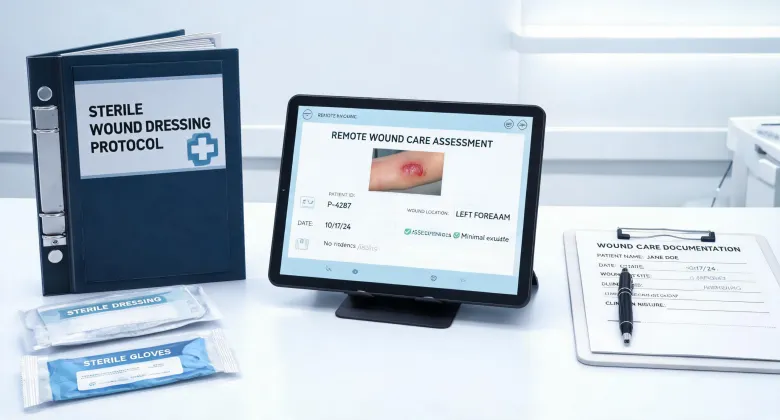
If you're looking for a molnlycke healthcare company overview, the short version is this: Mölnlycke Health Care is a Swedish medical device company that focuses on advanced wound care and surgical solutions. Their product lineup includes Mepilex silicone foam dressings, Mepiform scar management sheets, Melgisorb alginate dressings, Biogel surgical gloves, and Barrier surgical drapes and gowns.
Their best-known technology is Safetac®—a silicone adhesive that seals gently around the wound without sticking to the wound bed itself, reducing pain and skin trauma during dressing changes. It's backed by a substantial body of clinical literature, which matters when you're asking hospitals to trust a product with patient outcomes.
Equally important is what they don't make. Mölnlycke doesn't produce laboratory diagnostic equipment like hematology analyzers. They don't build electric wheelchairs or mobility devices. If you ask them about fluoroscopy imaging systems, they'll point you to a company that specializes in radiology. I know this because I've asked, and that's not speculation—it's been my experience with their representatives.
What "We Do Everything" Really Means
About once a quarter, a large medical distributor pitches me some version of the same pitch: "Consolidate your purchasing with us. We're comprehensive. One catalog, one invoice, one phone number." The catalogs are massive. Pharmaceuticals, durable medical equipment, wound care, laboratory analyzers, office furniture. Everything.
It took me 3 years and roughly 150 purchase orders to understand that "comprehensive" almost never means "excellent." In 2022, against my gut, I agreed to consolidate about 90% of our purchasing with one of these mega-distributors. The spreadsheet that convinced me looked beautiful. Fewer purchase orders, better volume pricing, one point of contact. My gut said something was off. I went with the spreadsheet anyway.
The numbers said consolidate. My gut said don't. I followed the numbers. Over the next nine months, every warning my gut had tried to send me came true.
The distributor's wound care products were okay. Just okay. When our clinical team pushed back on dressing performance, the distributor's reps couldn't explain the evidence behind what they were selling. When we had a quality complaint about surgical gloves, it took three days to get an answer, and even then it was a forwarding of the question to the actual manufacturer. When I asked for a recommendation on hematology analyzers for our lab, I got a catalog page number instead of clinical context.
They were excellent at managing purchase orders. They were not excellent at managing clinical confidence.
By January 2023, I was staring at an expense report that told the real story. The consolidation hadn't saved money—it had cost us. Rush orders to get proper products from proper specialists. Wasted inventory from the distributor that didn't meet our clinical standards. Management time spent untangling contracts. The total easily crossed $12,000, and I have the paperwork to prove it.
Why "We Don't Do That" Builds More Trust Than "We Have Everything"
That experience changed how I evaluate medical suppliers. When a company tells me what they won't do, I no longer read it as a limitation. I read it as a signal of where they've actually invested their resources and their reputation.
A wound care specialist like Mölnlycke has spent decades researching wound healing, developing Safetac technology, running clinical trials, and building expertise in exactly two categories: wound care and surgical products. That depth is why their dressings perform consistently and why their clinical support people can actually answer my questions without forwarding them up a chain. If they told me they also manufactured laboratory analyzers, I'd have to wonder whether their wound care R&D was being diluted by an unrelated division with different regulatory and engineering demands.
This logic extends beyond products. If someone at our facility asks "what is fluoroscopy?" I'm going to route them to a radiology specialist, because giving a half-informed answer about a complex imaging modality is worse than saying "that's outside my lane." The same principle applies to suppliers. A company that says "that's not our strength, here's who does it better" earns my trust for everything else they sell. In fact, the Mölnlycke rep who redirected me on a lab equipment question earned more loyalty from me in that thirty seconds than any glossy sales presentation ever has.
In Healthcare, Boundaries Protect Patients
Here's the part that makes this non-negotiable in a medical setting. In most industries, a mediocre product from a jack-of-all-trades vendor is an inconvenience. In healthcare, it's a patient safety issue.
When a hospital buys wound dressings for a chronic ulcer patient or surgical gloves for a six-hour procedure, the product has to perform at a clinical level. There's no room for "good enough." This is why I'm willing to manage more vendor relationships rather than fall for the lure of a single massive catalog. The administrative overhead of managing multiple specialists is real, but the cost of clinical mediocrity is far higher.
It's also why I push back when people assume that all medical supply companies are interchangeable. They're not. The company that spends its entire research budget on wound healing is not the same as the company that spends its budget producing electric wheelchairs or hematology analyzers. Different engineering, different regulatory pathways, different clinical evidence, different expertise. Respecting those boundaries isn't procurement inefficiency—it's how you protect both patient outcomes and your budget.
Isn't Managing More Vendors Inefficient?
I hear this objection constantly from procurement colleagues: "Dealing with 20 different specialist suppliers is a headache. Doesn't one big vendor make the whole process simpler?" I used to agree. I even argued that position in internal meetings back in 2022.
Here's what I learned the hard way. Transactional simplicity is not the same as operational efficiency. Yes, writing one purchase order is easier than writing ten. But when that one vendor can't answer a clinical question, can't explain the evidence behind their products, and can't resolve a quality complaint without a week of internal escalations, the "efficiency" disappears fast.
With specialists, when an issue comes up—and it will—the conversation goes differently. They know their product, they know the alternatives, they know the clinical data. The resolution is faster. The expertise is real. The supposedly extra work of managing more suppliers turns out to be less work than managing the fallout of a bad consolidation. I'm not a hospital administrator, so I can't speak to system-wide financial strategy. What I can speak to is the procurement reality: my $12,000 mistake proved to me that the transactional convenience of a one-stop shop doesn't survive contact with clinical reality.
My Procurement Checklist Now
I've rebuilt my vendor evaluation approach since 2022. Here's the checklist I now maintain for any new medical supplier relationship:
- Can they articulate their scope without hesitation? If they can't clearly tell me what they don't do, I walk away.
- Can they show me clinical evidence for their core products? Not brochures. Actual published clinical data.
- Are they willing to redirect me to another specialist when appropriate? A supplier who says "talk to these people, they're the experts" earns my trust for the next five years.
- Does their product portfolio cohere? A company that stays focused on wound care and surgical solutions makes sense to me. A company that tries to sell me wound dressings, wheelchairs, and lab analyzers all at once raises questions.
This is why I continue to purchase wound care and surgical products from Mölnlycke Health Care. Not because they claim to be everything to everyone, but because they're clearly excellent in their actual area of focus. And when I need something outside that scope—a hematology analyzer, an electric wheelchair, guidance on fluoroscopy—I'll go to a different specialist, and I'll trust that Mölnlycke would give me the same advice.
One caveat before I close: this reflects my experience as of early 2025, and product portfolios change. Always verify current offerings and clinical evidence before making purchasing decisions.
I've spent 8 years buying medical supplies, and the most valuable lesson I can share is this: the strongest signal in a vendor pitch isn't what they claim to do—it's what they openly admit they can't do. I'd rather work with a specialist who knows their limits than a generalist who overpromises. That's not just an opinion anymore. It's the conclusion of a very expensive field experiment.