I've bought wound care supplies for a 340-bed hospital for nine years. In that time, I've personally made—and documented—14 significant purchasing mistakes that wasted roughly $42,000 (yes, I tracked it; the spreadsheet is embarrassing). The costliest mistake wasn't a typo in a purchase order. It was choosing a cheaper dressing because the unit price looked smarter.
Here's the short answer to a question nobody says out loud: the cheapest dressing on your formulary is usually the most expensive one your patients will use. If you're comparing Mölnlycke Mepilex with Safetac technology against a lower-priced alternative, unit price alone will mislead you.
Why I'm the one who got this wrong
In my first year as supply chain coordinator (2017), a wound care nurse asked me to trial a different foam dressing because the current line was causing adhesive issues. She was right about the old product. I was wrong about the replacement.
The alternative cost $0.65 less per dressing than Mölnlycke Mepilex with Safetac technology. I compared the prices, called it a win, and approved the switch.
Nineteen days later, the pilot was dead. The new dressing created two skin tears when it was removed, and dressing changes went from every three days to daily. We saved roughly $403 on product and spent an extra $3,180 on nursing time and skin prep, plus a complaint review that ate a day of our quality team's time.
Let me be honest: I didn't learn the lesson from that one incident alone. It took me about three years and 14 documented mistakes to understand that a vendor's catalog price is the least informative number on the page. I wasn't buying a dressing. I was buying a healing pathway with a unit-price sticker on it.
What is a hospital bed, really?
That brings me to a question that sounds insultingly basic: what is a hospital bed? Most people say it's where patients sleep. I've watched supply decisions get made as if a bed is just furniture. But in wound care, a hospital bed is a clinical surface—the place where pressure injuries start, worsen, or heal. The mattress, the rails, the patient's position, the sheets: it's all connected to the dressing choice.
Once you start seeing a bed that way, you ask different questions. Is this patient on bedrest for 20 hours a day? Is the periwound skin fragile, damp, or intact? Does the dressing need to tolerate shear for three days? That's when I stopped asking "what's the cheapest 4x4 foam?" and started asking "what's the full cost per healed wound, including nursing time and complications?"
The math that changed my mind
In late 2019, I compared two dressings side by side for 90 days: a low-cost foam dressing and Mölnlycke Mepilex with Safetac technology. Same wound types, same care team, similar patient acuity.
The results surprised me—then embarrassed me, once I realized how long it should have taken to run this comparison. The cheap dressing was $1.10 per unit and needed changing twice a day, with an average of 10 minutes of nurse time per change. The Mepilex was $3.20 per unit and stayed on for three days. Using a fully loaded nursing cost of $38/hour:
Low-cost foam: $2.20/day in product + $12.67/day in nursing time = $14.87 per healing day
Mepilex with Safetac: $1.07/day in product + $2.11/day in nursing time = $3.18 per healing day
I do not mean that exact spread applies to every wound. But I do mean the "cheapest dressing is the best value" assumption comes from an era when foams were simple and nursing time was cheap. That era is gone.
The mammography call I still think about
In September 2022, I got a call from the breast imaging center. An 84-year-old patient had come in for a routine mammogram. She'd had a small abrasion on her forearm, and a dressing from our "affordable" foam line had been applied two days earlier.
During positioning, the dressing's acrylic adhesive—which had bonded tightly to her fragile skin—caught on the edge of the imaging equipment as she was repositioned. The skin around the dressing tore. We sent her for a wound care consult, rescheduled the mammogram, and updated her chart to flag fragile skin.
That's medical adhesive-related skin injury, or MARSI. The 2013 MARSI consensus review in the Journal of Wound, Ostomy and Continence Nursing documented how common these injuries are in older adults. Mammography was the last place I expected to change my wound care formulary. But after that call, I stopped approving adhesive dressings for patients with fragile skin unless the product used an atraumatic adhesive like Safetac.
Remote patient monitoring changed the calculus
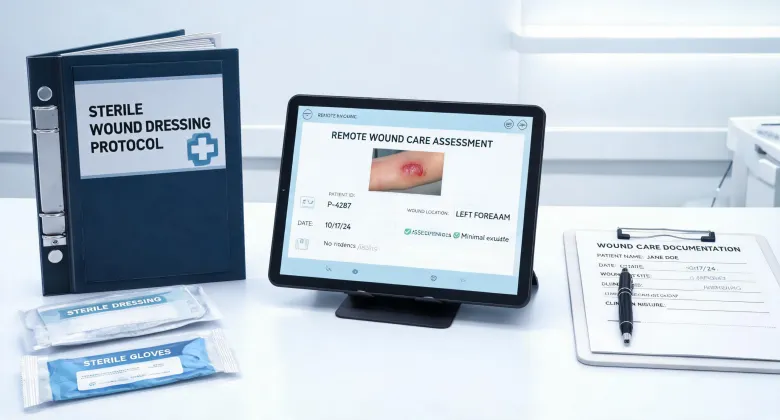
Then 2020 arrived, and a larger share of our post-acute wound care moved to telehealth. Remote patient monitoring for us didn't mean fancy home monitors. It meant a home-health nurse sending wound photos and a patient answering three questions over video.
Once that became routine, every additional dressing change became more expensive and riskier. A change at home requires either a paid nursing visit or a family member performing it. I once watched our telehealth nurse try to coach a patient's daughter through removing a stuck adhesive dressing—live, over video. Neither of them could see what was happening under the dressing as it pulled. That's the moment I understood that wear time is a patient-safety feature, not a convenience.
The checklist I use before switching any dressing
After the mammography incident, I wrote down everything that had gone wrong over the years and turned it into a checklist. It's now part of our procurement SOP, and it has caught 47 potential issues in the past 18 months:
- Calculate cost per healing day, not cost per dressing. Include nursing time, visit costs, skin-prep products, and complications.
- Screen the skin before you screen the price. Fragile skin, advanced age, or current steroid use? Change the options.
- Check real-world wear time. Approved wear time and actual wear time are often different. Ask the clinicians who removed the last 50 dressings.
- Verify the supply chain. We buy some products through authorized distributors of Molnlycke Healthcare US LLC to ensure traceable lots and intact packaging. Gray-market supplies can look identical and behave differently.
- Run a 30-day clinical pilot. Use bedside staff to document skin condition, pain during removal, and dressing adherence—not just the purchasing department's own spreadsheet.
- Track outcomes that matter: healing time, skin tears, dressing changes per week, patient complaints, and missed appointments.
When a cheaper dressing is genuinely fine
I don't want this to read as "buy premium for everyone." That would be just as lazy as buying the cheapest thing. A small wound on healthy, intact skin in a mobile patient doesn't always need Mepilex. And a heavily exuding wound may need an alginate first and a foam second—no advanced foam fixes a bad wound assessment.
The honest answer is: if the wound is simple, the skin is stable, and the patient isn't at high risk for skin damage, a lower-cost dressing is defensible. In our hospital, roughly one in five dressings we use falls into that category. The problem starts when price becomes the default filter and nobody checks whether the cheaper product changes the care pathway.
Also, a practical caution about my own numbers: they come from our internal audits, not a controlled trial. Your labor costs, patient mix, and contract prices will differ. Build the business case with your own data. As of February 2024, our GPO price for a 4×4 Mölnlycke Mepilex Border was $3.82 per unit—verify current pricing and FDA clearance before you commit to any change.
I'm not saying Mölnlycke products are magic. I'm saying the cheapest purchase order isn't the same as the cheapest care pathway. It took me $42,000 and a skin tear during a mammogram to learn that, and I'd rather you learn it from this checklist than from your own quality office.
