Here’s an opinion most vendors won’t put in their brochure: brand matters more in medical procurement than a lot of buyers want to admit. I’m not talking about logos or packaging. I’m talking about the clinical evidence, the product behavior, and the reputation that walks into a patient’s room before the clinician does.
I’m the office administrator for a 40-person ambulatory surgery center. Maybe 42, if you count the new advanced practice provider I keep forgetting to add to my own org chart. I process around 60–80 orders a year, across 20-plus vendors, and I report to both operations and finance. I’m not a clinician. But I’ve written enough purchase orders to learn a basic truth: the cheapest option can become the most expensive one.
Quality isn’t a luxury line item. It’s a risk-management decision.
Yes, Brand Perception Shows Up in a Supply Closet
Look, I’m not saying a hospital should buy the most expensive version of everything. I’m saying that when a nurse or surgeon opens a supply cabinet, the products inside tell a story. If the story is “we bought on price,” that story has consequences. Clinicians notice. Reps notice. Patients notice.
It took me about three years in this role to understand that a purchase order is also a brand statement. That shift didn’t come from a seminar. It came from watching our wound care nurse walk me through why she requested Mepilex instead of the unopened box of generic foam I’d ordered the month before.
What a Molnlycke Healthcare Company Overview Taught Me
When I search for a “Molnlycke healthcare company overview,” I don’t just see a company that started as a Swedish textile company in 1849. I see a company with a clear clinical position: protect the skin, support healing, and give clinicians tools they can trust. That’s not the same as a company that just happened to sell dressings.
Once I evaluated the Molnlycke Mepilex with Safetac technology against a few so-called equivalents, I understood why clinicians asked for it by name. Safetac is a silicone adhesive technology designed to seal around the wound edge without sticking to the moist wound bed. Put simply: less trauma to fragile skin on removal. That matters when you’re dressing a 74-year-old’s heel or a postoperative incision that needs to stay undisturbed.
To be fair, I didn’t understand that at first. When I saw the price difference between Mepilex and a basic foam dressing, I asked the obvious question: why are we spending more? The answer wasn’t a brochure. It was a demonstration. Our wound care nurse showed me how the Safetac layer behaved on a sheet of fragile paper—it held in place but didn’t rip the surface when removed. A standard adhesive did. That was the moment I stopped looking at dressings as tape and started looking at them as clinical tools.
When “Equivalent” Wasn’t Equivalent
I have an example I’m not proud of. Last year—no, two years ago, I’m mixing it up with the supply audit—I approved a cheaper foam dressing because the spec sheet said “silicone foam dressing.” I thought, what are the odds? Same category, same wound type, similar design. The odds caught up with me.
Within a month, our wound care nurse flagged two patients. The periwound skin was irritated, the dressing didn’t handle moisture the way Mepilex did, and staff had to change it more often to keep the skin dry. No one accused me of causing harm. But the email I got was polite, specific, and painful: “Can we switch back?”
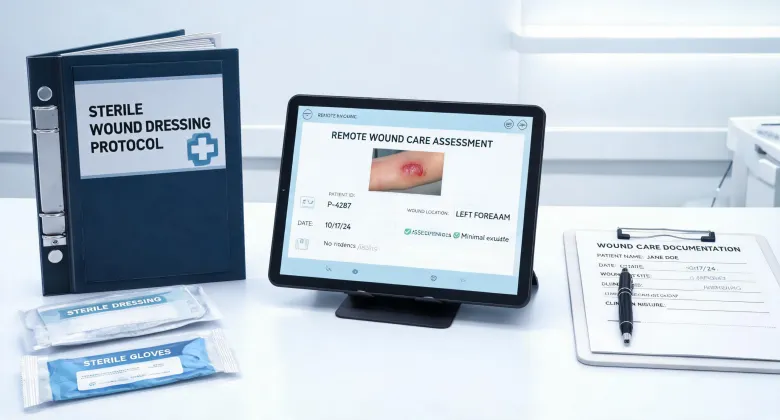
I can’t prove the cheaper dressing caused the irritation from one shared photo. But here’s the thing: nursing time is a cost. Patient comfort is a cost. Staff confidence is a cost. A product that makes a clinician hesitate, document more, and call the rep more is not a cheaper product.
The Same Logic Applies to an ECG Machine or a Medical Imaging System
Here’s an analogy that helped me argue this to finance. When our cardiology team reviews an ECG machine, no one asks, “Which one is cheapest?” They ask about accuracy, artifact handling, electrode compatibility, software updates, and service response time. When we evaluate a medical imaging system—say, a CT or MRI—we don’t buy on sticker price. We weigh image quality, workflow, radiation dose management, uptime, and training. The decision is clinical and operational, not just financial.
A wound care dressing is a medical device too. It deserves the same discipline. I once processed a quote for a vagus nerve stimulator—a niche device, but one that our team evaluated with the seriousness it deserved. We checked the evidence, the training materials, the long-term support. If we do that for a device that sends electrical signals to the nervous system, why would we accept a one-page spec sheet for a dressing that sits on broken skin?
Obviously, I’m not comparing a $6 dressing to a $60,000 imaging system. They are different financial risks. But the decision discipline should be the same: What is this product supposed to do? What happens if it fails? What support do we get from the manufacturer? When I answer those questions with a vendor, price becomes a smaller part of the story.
But Aren’t All Silicone Dressings the Same?
I know what some buyers will say. I said it myself. “It’s just adhesive. It’s just foam. You’re paying for marketing.” But the evidence changed my mind.
Not all silicone adhesives behave the same on skin. The technology behind them matters. Mepilex with Safetac technology has a long clinical history and a documented approach to minimizing shear and trauma on removal. The “equivalent” I bought had features that looked similar in a brochure but didn’t perform the same in practice. The difference wasn’t obvious in the package. It was obvious in the outcomes.
I’m not saying budget dressings have no place. I’m saying they should be evaluated on evidence, not on price per unit alone.
What I Do Differently Now
I don’t make procurement decisions for clinical products by myself anymore. I ask the people who use them. (Note to self: I should have done this much earlier.) I also ask for the clinical rationale behind a product before I sign off—not just a quote. In practical terms, that means:
- If a product has a brand name like Mölnlycke, I ask why clinicians prefer it. Usually there’s a technology or evidence story behind the preference.
- If a product is unbranded or “equivalent,” I ask for studies, regulatory documentation, and a trial with our own staff.
- If a vendor can’t provide in-service training or after-sale support, I change the conversation.
It’s not about being loyal to one brand. It’s about being loyal to the decision process.
Bottom Line
At the end of every quarter, I sit down with finance and go through the numbers. A dressing with a higher unit price can look like a mistake on a spreadsheet. I understand that. But a patient with damaged skin, a clinician who’s lost trust in the supply chain, a surgeon who has to explain why the “cheaper” product didn’t perform—those are costs no spreadsheet captures. I’d rather explain a slightly higher purchase order than explain why I ignored what the evidence was telling me.
I still buy generic products in non-clinical categories. Trash liners, copy paper, office supplies—fine. But for anything that touches a patient, I apply the same standard I would want if I were the one in the bed.
That’s the opinion. Took a while. Worth it.
