-
Scenario 1: Wound care and surgical products — Mölnlycke territory
-
Scenario 2: You need a nebulizer machine
-
Scenario 3: You need a fetal monitor
-
Scenario 4: You need gel electrophoresis equipment
-
How to tell which scenario you're in
-
The 10-minute pre-order check
-
Why prevention beats correction
-
When to move fast — and when to slow down
-
If you remember one thing
There's no single answer for an urgent medical product request. The right checklist depends on what you're ordering. A box of Mepilex border dressings is not the same challenge as a nebulizer machine. A fetal monitor isn't the same as a gel electrophoresis system. Pretending they're all 'medical supplies' is how delays happen.
I coordinate rush orders for hospitals, clinics, and surgery centers. In my role, I've learned that the word 'urgent' tells me very little. What matters is the category.
Here's the four-way triage I use:
- Wound care and surgical products like Mölnlycke dressings and gloves.
- Respiratory support, including a nebulizer machine.
- Maternal-fetal monitoring, meaning a fetal monitor.
- Laboratory diagnostics, for example gel electrophoresis equipment.
When I compared routine restock orders and true emergency orders side by side over a year, I realized something: most 'emergencies' were created by vague specifications, not by short timelines. The time we thought we were saving by skipping verification was actually the time we spent reordering later.
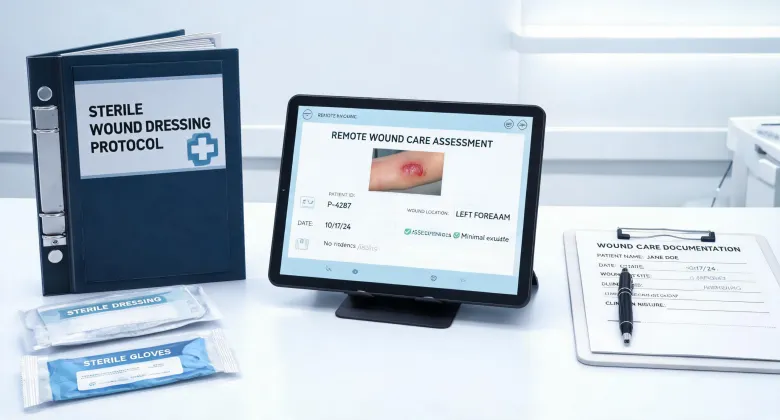
Scenario 1: Wound care and surgical products — Mölnlycke territory
If the request is for a Mölnlycke product, the first question is not 'which brand?' It's 'which exact product code?' Mölnlycke Health Care AB makes a broad portfolio: wound dressings such as Mepilex, Mepiform, and Melgisorb; surgical gloves under the Biogel name; and surgical drapes and gowns in the Barrier line. In most procurement databases, the name gets typed as 'molnlycke' without the accent. That's fine, as long as the legal entity on the label is verified.
Here's why legal entity matters. The product label tells you who is legally responsible for the device. For Mölnlycke, products sold internationally often carry Mölnlycke Health Care AB on the label. In the US, the entity can appear as Mölnlycke Health Care US LLC. If your supplier file mixes those two up, the device documentation and adverse event reporting process gets messy.
The clinical spec matters more than the brand family. 'Mepilex' alone isn't enough. Is it foam, border, or sacral? Sterile or non-sterile? What size? Does the protocol require Safetac®? That's the silicone adhesive technology designed to reduce skin trauma on removal, and it's one of the key reasons clinicians choose the product. But you still need the product code to be correct.
Scenario 2: You need a nebulizer machine
Now we're in a different category. A nebulizer machine is a medical device that converts liquid medication into an aerosol. It's not a consumable, and it's not a Mölnlycke order in most cases. If you're a distributor or procurement specialist, your checklist needs to change.
What to verify for a nebulizer machine:
- Type: jet, mesh, or ultrasonic — they're not interchangeable for every medication.
- Particle size: the target range for lower airway delivery is usually 1–5 microns.
- Compressor specifications, if it's a compressor-based system.
- Cleaning and disinfection method.
- Standard medication cup compatibility.
Why does this matter? Because a 'nebulizer machine' without a model number is a conversation starter, not an order. I've seen three different 'nebulizer machines' arrive for the same request, and only one matched the medication delivery protocol.
In March 2024, a clinic called at 3 p.m. with a nebulizer machine request for a patient-home program starting the next morning. Normal order cycle was five days. We found a regional supplier with the exact model, paid $85 in courier fees, and delivered by 8 a.m. The alternative was 20 patients missing their first home treatment session. That order worked because the specification was precise. We knew the model, the cup, and the tubing before we called the courier.
Scenario 3: You need a fetal monitor
A fetal monitor is not one thing. It might mean an external fetal heart rate monitor, a tocodynamometer, or a system with internal scalp electrodes. It could be for antepartum testing or intrapartum monitoring. Those choices affect the transducer, the cables, the software, and the training.
If someone asks for 'a fetal monitor,' slow down. Ask:
- Which exam room or department?
- What transducers are required?
- Does it need to connect to the hospital EMR?
- Are clinician training materials needed?
Honestly, I'm not sure why so many fetal monitor requests omit the transducer model. My best guess is that people think the monitor is the whole system. It isn't. The monitor is only as useful as the probes that plug into it.
Scenario 4: You need gel electrophoresis equipment
If you've ever asked, 'what is gel electrophoresis?' — you're not alone. It's a laboratory technique that uses an electric field to separate molecules like DNA, RNA, or proteins by size and charge through a gel matrix. It's not a bedside clinical product. It's lab equipment, and that changes the procurement process.
For a gel electrophoresis system, the key questions include: is the lab running DNA on agarose gels or proteins on polyacrylamide gels? What power supply voltage and current are needed? Does the system come with a casting tray and combs? What buffer system will the lab use? 'One electrophoresis setup' doesn't work for every protocol.
I learned never to assume 'same system' means 'same configuration' after an order for a gel electrophoresis kit. We assumed the power supply was included. It wasn't. The lab waited another three days. That's the kind of mistake prevention is meant to catch.
How to tell which scenario you're in
Ask three questions before you search for a supplier:
- Is this a consumable or a device? Dressings and gloves are consumables. A nebulizer machine and a fetal monitor are devices. Gel electrophoresis equipment is laboratory capital.
- Does the clinical protocol specify a brand? If it says 'Mepilex,' don't substitute. If it says 'nebulizer machine,' you need a device spec, not a brand name.
- Who will use it? Wound care nurse, respiratory therapist, midwife, or lab scientist? Their training needs are different.
The 10-minute pre-order check
I use this checklist for every urgent order, and it has saved more order cycles than I can count:
- Legal manufacturer and entity — for Mölnlycke, that's usually Mölnlycke Health Care AB or Mölnlycke Health Care US LLC.
- Exact product description: size, presentation, sterile or non-sterile, quantity.
- Device regulatory status: FDA 510(k), CE marking, or other applicable clearance.
- Compatibility: transducers, power supply, gowns, drapes, adhesives, buffers.
- User training and instructions for use.
- Stock confirmation and honest delivery time.
If a vendor can't share an ISO 13485 quality management certificate or equivalent regulatory documentation, that's a red flag. In medical procurement, speed does not override traceability.
Why prevention beats correction
Five minutes of verification beats five days of correction.
I've said this to every new coordinator I've trained. The small checks — reading the label, confirming the entity, checking the transducer model — are the cheapest insurance a hospital can buy.
This is uncomfortable when someone is waiting for an order. But the truth is, a rush order built on an assumption is just a rework order that hasn't happened yet.
When to move fast — and when to slow down
Move fast when the request is unambiguous. A Mölnlycke product code with a confirmed size and expiry. A nebulizer machine with a model number and a medication cup reference. A fetal monitor with an ordered transducer list. A gel electrophoresis system with an application and a full accessory list.
Slow down when the request is vague. 'We need a nebulizer machine' is the beginning of a conversation. 'We need a fetal monitor' is not enough to order. 'We need gel electrophoresis' needs a scientist in the room.
If you remember one thing
The right order is the one the clinician can use immediately. In wound care and surgical supply, that often means knowing Mölnlycke's portfolio better than the search results. For a nebulizer machine, fetal monitor, or gel electrophoresis equipment, it means knowing the specifications before anyone promises a delivery time.
Speed is good. Clarity is better. And a 5-minute pre-order check is how you get both.
