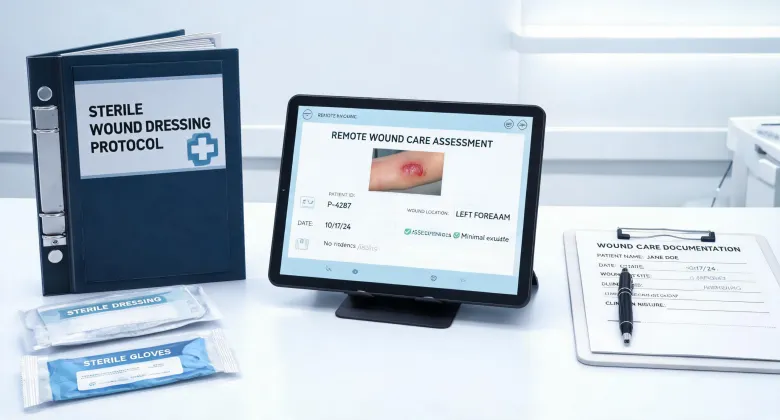
Ask me what Mölnlycke is, and I'll give you two answers. First, yes, it's the Swedish health care company that makes wound dressings, surgical gloves, drapes, and gowns. Second, in the procurement world, it's a useful benchmark for a question I keep asking: should we buy from a focused specialist or from a broadline distributor?
I've spent six years managing medical supply purchasing for a regional hospital. Our budget runs roughly $3.1 million a year, and I've processed enough purchase orders to know that the lowest unit price is a dangerous myth. It took me a few years to understand that the supplier's expertise boundary matters more than its catalog size.
This isn't a review of every Mölnlycke product. It's a comparison of two buying approaches, using Mölnlycke Health Care as the focused-manufacturer example. If you're debating between a specialist and a one-stop supplier, the framework below is what I wish someone had given me in year one.
The comparison framework
When I compare medical supply vendors, I use three dimensions:
- Catalog breadth vs. clinical depth — how much you can buy versus how deeply the vendor knows each product.
- Unit price vs. total cost of ownership (TCO) — the quoted number versus what it actually costs to receive, train, and manage.
- Boundary honesty — whether the vendor knows what it is not good at.
You might think this is only about wound care. It isn't. The same framework applies to surgical robots, nuclear medicine consumables, and even ECG vs. EKG ordering labels. Let me take each one.
Dimension one: catalog breadth vs. clinical depth
Broadline distributors have a legitimate edge: scale. A distributor can send one truck with 400 SKUs, from IV pumps to printer paper. That simplifies invoicing and receiving. If your facility is small or your clinical needs are general, this is real value.
A focused manufacturer like Mölnlycke works differently. They don't try to be everything. Their portfolio centers on wound care and surgical products: Mepilex for moisture management, Mepiform for scars, Melgisorb for exudate, Biogel surgical gloves, and Barrier drapes and gowns. That narrow focus feels limiting until you look closer.
In my experience, focused manufacturers bring different resources to the conversation. Their sales reps understand the clinical evidence behind their products. They can explain why a product was designed a certain way. For example, Safetac is a soft silicone adhesive layer designed to adhere to intact skin rather than the wound bed (source: Mölnlycke product literature). That kind of design detail rarely comes from a distributor's catalog.
Broadline distributors have many brands, but they don't own many of them. So when a clinician asks "which dressing should I use here?", the distributor may offer several options without a recommendation. A specialist has to commit to an answer. Most of the time, I'd rather work with someone who commits and then explains the evidence.
Dimension two: unit price vs. total cost of ownership
This is where my opinion changed. In Q2 2024, I compared quotes for a surgical glove contract. The broadline distributor was 12% cheaper per box. On paper, the decision looked obvious.
Then I added the hidden costs.
The distributor's gloves came in multiple manufacturing lots. Sizing was inconsistent. Our receiving team spent extra time checking lot numbers. One case had to be set aside due to a packaging defect. The gloves weren't necessarily bad, but every inconsistency generated a cost. When I added receiving labor, returns processing, and clinician time spent double-checking packaging, the 12% price gap nearly disappeared.
I've seen this pattern many times, but I do not mean just a few orders—I mean across hundreds. The trigger event for me was in March 2023, when a shipment of contract dressings was substituted with an equivalent brand without advance notice. The product worked fine, but the packaging was unfamiliar, and two nurses initially used the wrong protocol. Nobody was harmed, but it showed me how a "free substitution" can create a safety-relevant mess.
Now I use a TCO model that includes a small penalty for SKU instability. When I negotiated our master agreement with Mölnlycke Health Care US, I appreciated that the contract specified product names, item codes, and substitution rules in one place. On our side, we also added a simple receiving check: verify the Mölnlycke Health Care logo and lot number on each carton. That sounds bureaucratic, but it catches parallel imports and discontinued packaging before they reach the floor.
Dimension three: "we don't do that" — and why it wins trust
The third dimension is the one I learned last. A few years ago, I asked a supplier representative whether they could also help with nuclear medicine supplies. The answer wasn't "yes" with a vague promise. It was "no—that's not our area, and you'd be better off with a specialist in that field."
That answer startled me. But it also made me trust that rep for everything else they claimed.
This is what I mean by expertise boundary. Mölnlycke doesn't sell surgical robots. I don't expect them to. If I'm buying a surgical robot, I want a vendor that can show me service response times, surgeon training, and imaging interoperability metrics. Bundling a robot with wound dressings in one contract would make the costs harder to see, not easier.
The same goes for nuclear medicine. It has its own regulatory chain, from isotope delivery to shielding and imaging protocols. A focused manufacturer who doesn't pretend to know nuclear medicine is more credible than an overpromising salesperson who says "we can handle all of that." I'd rather have a vendor who tells me what to buy from someone else than one who implies they can do everything—but does none of it well.
It took me about three years and 200 purchase orders to understand that the vendor who says "this is what we're good at" is more predictable than the vendor who says "absolutely, we can do all of it."
A small side example: ECG vs. EKG
Even something as simple as ECG vs. EKG can expose the difference between specialist and broadline thinking. According to the National Library of Medicine's MedlinePlus, ECG and EKG are both abbreviations for the same test: electrocardiogram. The EKG spelling comes from the German Elektrokardiogramm.
In purchasing, this isn't just a spelling lesson. If your inventory system has both "ECG electrodes" and "EKG electrodes" as separate line items, you can end up with duplicate SKUs, different prices, and stock imbalances. A specialist in cardiac diagnostics would standardize that nomenclature and force one item number. A broadline distributor might not, because their catalog is too large to care.
That's a microcosm of the whole comparison. The issue isn't name recognition. It's whether someone has taken the time to reduce your friction.
When the specialist loses
Now for the surprising part: the specialist doesn't always win.
If you're a small clinic with modest wound care volume and no surgical program, a broadline distributor is probably the better choice. You won't need the same level of clinical support. You'll value the ability to order everything in one call, from dressing supplies to ECG electrodes. The narrower portfolio of a focused manufacturer becomes a liability.
Our own threshold became clearer after I built a cost calculator. For every additional vendor, I add about 7% overhead for contract management, credentialing, and purchase orders. That number isn't scientific—it's our organizational reality. But it forces the conversation to be honest. A specialist's price premium may be justified only when the total spend in that category is large enough to absorb its benefits.
For a mid-size hospital with a busy OR and wound care program, the scale tips in favor of a specialist for specific categories. For a clerk buying ten items a month, it doesn't.
Final takeaway
Don't ask "which supplier is better?" Ask "better under what conditions?" That distinction matters more than any brand name.
Mölnlycke Health Care US is now part of our supplier map, not because a logo on a box changes outcomes, but because the company draws a clear boundary and invests deeply where it says it's good. That's worth a lot to someone managing a budget, a clinical team, and a handful of sure-footed vendors.
Still, I don't buy on autopilot. I check the evidence, the TCO, and the substitution policy. And when a rep tells me that something outside their specialty would be handled better elsewhere, I take it as a good sign.
That's the real lesson. In procurement, as in medicine, knowing the limit of your expertise is a feature, not a flaw.
